Originally published on Nat’s Substack
The past four weeks of my life have passed by like a long Sunday afternoon. Teetering between the chokehold of adult responsibility and the gravitational pull of the laziness of catnapping in cracks of sunlight, I feel a mixture of hope and dread in my stomach, winding up my nerves like a fishing line. Some days pop like bubbles on my fingertips, while others stretch on and on like a pull of chewing gum through clenched teeth.
There are a few things that make my time, in this purgatory of sorts, feel whole: writing, photography, nature, and music. I’m learning slowly that creating more than I consume actually might heal my psyche. So, here I am, creating some Frankenstein combination between the song I have on repeat and the writing I’ve neglected for two months: some sort of lyrical analysis slash self-reflection centered around the masterpiece that is “It Girl” by Ashnikko.
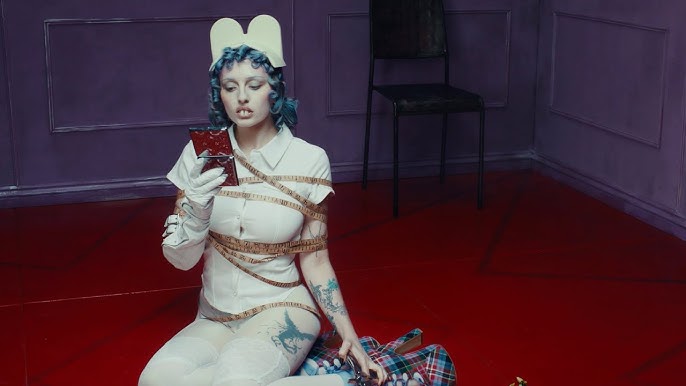
Placed at the very end of her new album Smoochies, “It Girl” feels like the culmination of all the small pockets of pain and dissociation that are laced throughout the songs that precede it. In an interview with Fader, Ashnikko discusses the inner turmoil that the song addresses, specifically relating to the concept of “it girl-ism” in mainstream media—its superficiality, hollowness, and intangibility. In relation to the song, the artist said in the interview: “I want for my girls, for my friends, for my mom, for my future children to just experience the whole spectrum of the human experience and not to have to solely trade in beauty currency because it is so tiring.”
And in “It Girl”, some of the very first lyrics of the ballad read:
You could buy the whole world with a face like that
I cried lookin’ in my mama’s makeup bag
I’m hollowed out, I look good
Treat me like termite wood
As much as this dilemma is a symptom of being under the scrutiny of Hollywood spotlight, I fear that it is much more relatably comorbid with the feminine experience as a whole. From the moment I had independent exposure to digital media, so much of my mental energy has revolved around attaining and maintaining being beautiful. As a teenager, I religiously applied a full clown-face of makeup every day before school. Looking back, it’s ludicrous to think about walking through the halls of a small town New Jersey high school in full glam, but someone had to do it, I suppose. The pressure to remain beautiful leaked like toxic fluid into my adult years, and throughout college I strived for not only the perfect face, but the perfect body. I woke up, again religiously, at 7 a.m. everyday to go to the gym and, building precisely intentional muscle on top of my naturally thin frame, I felt like I was starting to win the it-girl lottery, if you will. For a long time, through working out, or through my inexplicable, yet impervious, anxiety around eating, I felt beautiful.
But as I’ve grown into a full-on adult, an adult body came too, and now the weight on my hips and thighs and the fullness of my cheeks leave me feeling stripped down and vulnerable. I no longer have the protection of skinnybeauty on my side and instead find myself engrained with the thought that I am, at best, average looking—as though nothing could be more terrifying.
I’ve learned as I’ve gotten older that, more than most would like to admit, beautiful is a starving feeling, something to be fed. In its basic and raw form, beautiful is a silhouette against a lit up apartment window, the outline of a real thing, a non-existent shadow that is only visible in the context of what surrounds it. It doesn’t feel warm or text you back or love you. It doesn’t tattoo your skin, outlining shapes to stick onto your corpse forever.
Learning to love yourself, when you are forced to let go of the way that beautiful makes you feel, is like free falling from the sky with no parachute, letting the atmosphere and the gravity and the adrenaline hold you in a way that only God knows how. It feels shifting and uncomfortable, like shedding a lizard skin only to reveal a version of yourself that is pink and green and new but genuine. Suddenly, like Ashnikko sings, it feels like the weight and threat of violence lays on your waistline and like this burden is too wide and too heavy to bear.
But despite how impossible it might feel to escape beautiful’s grasp, I’m learning that it’s possible. I feel beautiful when I take a captivating photo or when I sing in my car or when I write a metaphor that warrants compliments or when I sit on the bank of the Mississippi River. I feel beautiful alone. It’s been hard to recognize, but I know that one day I’ll feel beautiful all the time too.
Not only does Ashnikko’s song address the vulnerability and fallacy of aiming to be beautiful and desirable, it directly recognizes, through her lyricism, the pressure that patriarchal society places on women to perform a role that serves the men in their lives. The whole song, in reality, is about the tension between authentically existing and playing girl to the people who perceive you as such, a tension that would not exist without the male-centered structure that society takes on. Ashnikko addresses men several times throughout “It Girl,” explicitly mentioning the men in her family and only alluding to the other men that exist in her life. I find the choice to address her brothers and her father specifically to be poignant and important—it shows how, even in our most vulnerable, familial, and supposedly safe relationships with men, we are still plagued by a dynamic where patriarchy has a tight grip on our self-perception. Ashnikko sings:
Eldest daughter, open water
My lеgs look like baby seals
And I am not a vessеl for men to love themselves anymore
The pressure of being the eldest daughter in a family structure is suffocating and, regardless of how responsible or put-together or successful you may be, you always feel like a fawn wobbling on newborn legs, a boat in “open water” without a lighthouse to lead you to shore. I want to be like her for my brother and be successful for my mother and be open-hearted for my father. The current stillness of my life, the lack of control, and dwelling on the concept of entropy, I feel like I’m failing everyone. Now I’m not only ugly, I’m not even changing the world.
The final line of this verse is a concept I’ve been tortured by for the entirety of my life. In a vacuum world, soundbite situation, it seems as though the last line might be addressing male lovers. But in the context of the song, the “men” includes man in every sense, as she positions herself as “eldest daughter” in relation to the male members of her family. It’s this positioning that rips my heart out of my chest because, like her, I have found myself checkmated in the same square, on the same chessboard. De-centering men, regardless of what role they play in your life—for me, not as lovers, but as people—rips away another layer of what beautiful means. You can’t be an it girl without men’s desire and approval there to prove it. Deconstructing the idea that to be loved, romantically or familially or platonically, is to be valued by men has been the hardest thing I’ve had to teach myself. I’m glad Ashnikko uses this song to address the nuances of this in relation to it girl-ism.
The second and final chorus of “It Girl” reads as follows:
I wanna kill the it girl in me
Hold her silk pillowcase over her face in her sleep
I watch the light leave her eyes, deepen my smile lines
Now I’m finally, finally mine
And then, the solemn outro:
All the pretty girls die at twenty-seven
Die at twenty-seven
A smooth-faced legend
Isn’t that heaven?
Growing into womanhood or whatever you want to call it, I have had to massacre versions of myself that lived before in order to remain whole. If the parasitic version of yourself, who loves beautiful, stays living for too long, it begins to eat you alive—starting at your finger tips and finally reaching into the caverns of your heart. And it hurts the most to kill some articulation of yourself because it’s you and, no matter how flawed or how superficial or how venomous this person is, it’s still a version of you that had a childhood and fell off their bike and went to prom and got their heart broken. It’s still a piece of your identity that can no longer exist in order for you, the real you, to survive. And I mourn each ghost of me that I have let go of. I leave flowers on their graves and I cry for them at night and sometimes I wish they still breathed. But I know that the me that lies at my core, underneath the layers of dirt and my tectonic plates and my oceans, that me won’t miss them at all.
I’m proud of myself for making the progress I’ve already made in the battle against who I was. I’m becoming free and confident and unafraid of who I am. I still struggle to face myself in the mirror some days, and I often feel fettered by reminders of what I used to look like at seventeen. But, the point is, I’m at least trying to let go of the cancerous idea of beautiful that I’ve built up in my head, and surely that counts for something.
I turn twenty-seven in five months. I hope that by then, the vanity and ego that have made loving myself so hard have been evicted from my walls and no longer take up space in my brain’s real estate. I hope that I can make my family proud without driving myself insane. But mostly, I hope that by then, the pretty girl that dies on my golden birthday takes beautiful with her on the way out. ∎
 The Dilettante